
Survey first: $300–$750
A recorded camera run with distances marked. Yours to keep, and usually credited if the work goes ahead.
We camera the line first, show you what is actually wrong, and then tell you whether relining is the right answer. Often it is. Where the pipe has collapsed or lost its fall, it is not, and we will say so rather than sell you a liner that disappoints.
A resin-saturated liner is drawn into the existing pipe through an access point, inflated so it presses against the wall, and cured until it hardens. What you are left with is a continuous pipe inside the old one, with no joints along its length and a slightly smaller bore than the original.
Nothing is excavated, and the cured surface is smoother than the clay or concrete it lines, so flow is typically maintained or improved despite the small loss of diameter. On a property where a driveway, mature garden or paving sits over the line, that is the whole argument.
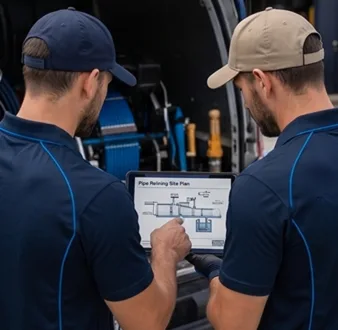
A food premises line narrows with hardened fat long before it fails structurally. Relining a greased line without addressing the grease simply gives you a smooth new surface to coat, and the interval to the next problem barely changes.
The right sequence is jet it clean, camera it properly, and then decide. If the barrel is sound the answer may be a service schedule rather than a liner. Where the camera shows cracks or open joints under the build-up, relining is worth doing and the smoother bore genuinely slows re-accumulation.
Alexandria once drained through Shea’s Creek, today’s Alexandra Canal, and its flat blocks still shed stormwater slowly, so older drains overload in a downpour.
Most people associate relining with sewers, but stormwater suffers the same failures and reline just as well: cracked lengths, open joints, roots, and sections that have silted because the fall has flattened. On a property that floods in every serious downpour, the line is often the reason rather than the rain.
The camera run matters more here than anywhere. Clearing a surcharging pit at the height of a storm tells you almost nothing; the same line inspected on a dry day tells you whether you have a blockage or a defect.
Clay and earthenware sewer lines laid beneath the cottages and factories around Botany Road and McEvoy Street are now a century old, and cracked joints are the suburb’s number-one blockage trigger.
Clay is rigid, round and predictable, and that geometry is exactly what a liner wants. The resin sleeve cures hard against a barrel that holds its shape, and the short pipe lengths that make clay joint-heavy are the same joints the liner seals in one pass.
So the material that causes the most recurring blockages in older streets is also the easiest to repair properly without digging. That is a genuinely lucky combination and it is why relining suits this housing stock so well.
Removing a mature tree is expensive, often needs approval, and frequently does not solve it: the roots already inside the pipe do not leave when the trunk does, and the joint is still open for the next one.
Mature figs and plane trees around Alexandria Park and Sydney Park push roots into any hairline crack in ageing sewer lines beneath the footpaths.
Relining lets both things be true at once. The garden stays as it is and the drain stops being a route to water. For most owners that is the whole appeal, and it is why no-dig gets specified on established blocks far more often than on new ones.
In a strip of tenancies the drainage is frequently shared, which means the fault is often not under the premises reporting it, and the party who pays is not always the party who called.
That is worth settling before the quote rather than after. Camera footage with distances marked from a known access point is what makes the conversation with a landlord or a neighbouring tenant short, because it shows exactly where the defect sits.
On a clay line the barrel is usually fine. What has gone is the mortar or rubber ring at each joint, and there is one every few hundred millimetres, which is a great many small openings after sixty or eighty years in the ground.
That matters for the quote. You are not replacing a pipe, you are sealing a long series of joints, and a liner does the whole run at once rather than patching them one at a time.
A recorded camera run with distances marked. Yours to keep, and usually credited if the work goes ahead.
The prevailing 2026 Sydney range for residential sewer relining.
Proportionate for one fault in a sound run. We will recommend it over a full liner when that is what the camera shows.
For a run failing along its length, which on old clay is the common finding.
Plus reinstatement. On a bare lawn it can win. Under anything you would miss, it usually does not.
These are market ranges, not our price. Nothing is quoted before the survey, and nothing starts before you agree it. Figures here are indicative of the 2026 Sydney market rather than a quote from us, you get your own number as a fixed price before any work starts.

Nothing is priced until a camera has been down the line. The survey is recorded, distances are marked from a known point, and the footage is yours.
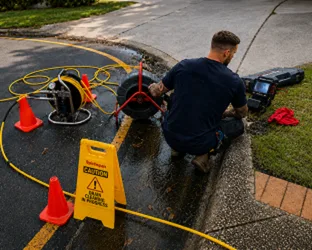
A single defect in a sound run wants a patch. A run failing along its length wants a full liner. A collapsed or sagging section wants excavation. The camera decides, not the quote.
Jet clean, install through the existing opening, cure in place. Water is off for part of the day and nothing above the pipe is disturbed.

Junctions reinstated, final camera run, and the compliance paperwork where the work is notifiable. You keep both recordings.
Leave your details and a licensed plumber will call back to arrange the survey. No quote is given before someone has seen inside the pipe.
Straight answers on price, durability and when to dig instead.

Ring us or leave your details. You will get a time for the inspection, not a price invented over the phone.

Leave your details and our local Alexandria team will call you back fast.